Loading... Please wait...
-
Products
- Piezometers
- Inclinometers
- Strain Gauges
- Data Loggers
- Time Domain Reflectometry (TDR)
- Displacement Transducers
- Extensometers
- Settlement Sensors
- Pressure Cells
- Load Cells
- Tiltmeters · Pendulums
- Readouts
- Visualization Software
- Stressmeters
- Distributed Fiber Optic Sensors
- Temperature
- Instrumentation Cables
- DeAerators
- Vibration Monitoring
- Custom Instrumentation
- Discontinued
- Support
- Training
- Contact Us
- News
- Company
- Projects
- Resources
- Videos
- Links
- Home
- News
- Newsletter
- December 2008
- Case History 2008
News
Case History 2008
Roman Galleries | Lisbon, Portugal
One of the rewards of working in the geotechnical instrumentation industry is the opportunity to contribute to the preservation of extraordinary historical landmarks. Geokon’s agent in Portugal, CÊGÊ, participates in the monitoring program for Roman-built galleries located beneath Rua de Prata in downtown Lisbon. The galleries went unnoticed for centuries until they were exposed in 1755 following a large earthquake that left half the city destroyed.
The structures date from between the 1st century BC and 1st century AD. When it was discovered that several cracks amongst the ancient ceilings, tunnels and floors were moving, CÊGÊ presented a structural monitoring proposal to the city. As a result, several Model 4420 Vibrating Wire Crackmeters and a Model 4999 Terminal Box were installed to allow precise readings to be taken without entering the structure. This is very important because the galleries are typically flooded and closed, with the exception of a 3-4 day period each year when the galleries are drained for inspection, by archaeological staff, and viewing by the public. The waterproof design, and the ability to run long cable lengths without signal degradation, were recognized as critical advantages of the Model 4420.
As a result of the monitoring program, CÊGÊ observed that crack movement was caused by draining the galleries and, after cross-referencing data from piezometers installed in the same area, by a fluctuating (tidal) water table. Readings are currently taken in the galleries twice a year and cyclic variation of the cracks ranges from 0.330 mm to 0.945 mm.
Our thanks to CÊGÊ for sharing this interesting case history.
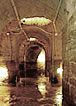
Roman Galleries
The galleries are open to the general public only once a year for 3 days.